


Looking for the best equity crowdfunding sites to fund your company? You’re in the right place.
Crowdfunding is one of the most powerful ways for startup founders, business owners, and real estate sponsors to raise capital online.
Just like how product creators launch campaigns on Kickstarter or Indiegogo, startups can now raise investment capital through equity crowdfunding platforms.
This is known as Regulation Crowdfunding (or Reg CF), and it allows everyday investors to fund early-stage companies in exchange for equity. You can raise upwards of $5 million!
And – it doesn’t have to be complicated. There are platforms that quickly connect founders with investors, making it easier than ever to secure pre-seed, seed, or growth funding.
In fact, I’ve been coaching students step by step through the process since 2012, when this industry was still in its infancy. I’ve also been interviewing equity crowdfunding success stories on my podcast, Crowdfunding Demystified.
But, I still get loads of questions from readers and students about equity crowdfunding.
That’s exactly why I compiled this list of the best Reg CF crowdfunding websites and portals, with fees, investor counts, and track records for each.
If you want to make sure you don’t fall flat on your face with your Reg CF raise, I’ve put together a step-by-step equity crowdfunding framework.
You can grab a copy on Amazon and steal the proven marketing tactics, investor acquisition strategies, and capital-raising processes used in real campaigns.
You can also take my free course, which reveals exactly how to raise funds, get investors, pick the right platform, and more.
Now, let’s get into the list!
1. WeFunder

With over 1.5 million investors and 4,000+ founders who’ve raised over $1 billion on the platform, Wefunder remains the largest Reg CF equity crowdfunding platform on the scene.
One of WeFunder’s notable alumni, Beta Bionics, went public at a ~$1 billion valuation after raising $234 million in an IPO
They are a great Reg CF platform for unique companies hoping to raise investment capital online because they cater to almost every niche imaginable and have funded hundreds of startups.
WeFunder is also known for having helped the Obama Administration pass the JOBS Act in 2012, which legalized equity crowdfunding, and they boast that they are on a mission to “fix capitalism.”
Campaigns on WeFunder are required to raise at least $50,000 to be promoted to the Wefunder marketplace. Successful campaigns are charged a fee of 7.9% of the total fundraise, plus a $1K/year platform fee (SPV included).
2. StartEngine

StartEngine was founded with the mission to help startups raise investment capital online, and they have since become one of the fastest growing Reg CF websites.
Following their acquisition of fellow Reg CF platform SeedInvest in 2023, they now host a community of over 2.1 million investors — making them one of the largest retail investor networks in equity crowdfunding.
Raises on StartEngine can take place through Reg CF and Reg A+. StartEngine also operates a secondary marketplace where investors can trade private shares — a liquidity feature that makes the platform more attractive to investors and, in turn, to the companies raising on it.
Tech startups do particularly well on StartEngine, and the platform boasts alumni like Knightscope, the autonomous security robot company, which raised over $77 million in equity crowdfunding on StartEngine. They then listed on the NASDAQ in 2022.
Also, Atlis Motor Vehicles, an all-electric truck manufacturer, raised more than $69 million across nine funding rounds before completing their own IPO that same year.
3. Republic.com

Republic.com is an equity crowdfunding portal that enables startups, real estate, video games, and crypto to get investment capital from the crowd. It’s licensed as both an SEC-registered funding portal and a broker-dealer, so it can host Reg CF, Reg A+, Reg D, and Reg S offerings under one roof.
For founders, Republic states that for most Reg CF offerings, it collects 7% of the total amount raised plus 2% of the securities offered in a successful financing. The 7% comes out of the raise itself, and issuers may also use proceeds to cover escrow and other offering costs.
Commissions for Reg A+, D, and S offerings run through OpenDeal Broker and are variable.
The platform also charges investors a 2.5% administrative fee with a $5 minimum and a $250 cap, though this varies by offering and is refunded only if a deal is canceled or withdrawn.
According to Republic.com, the platform has deployed over $2.6 billion across roughly 3,000 raises, with a global community of 3 million members.
4. Dealmaker Securities
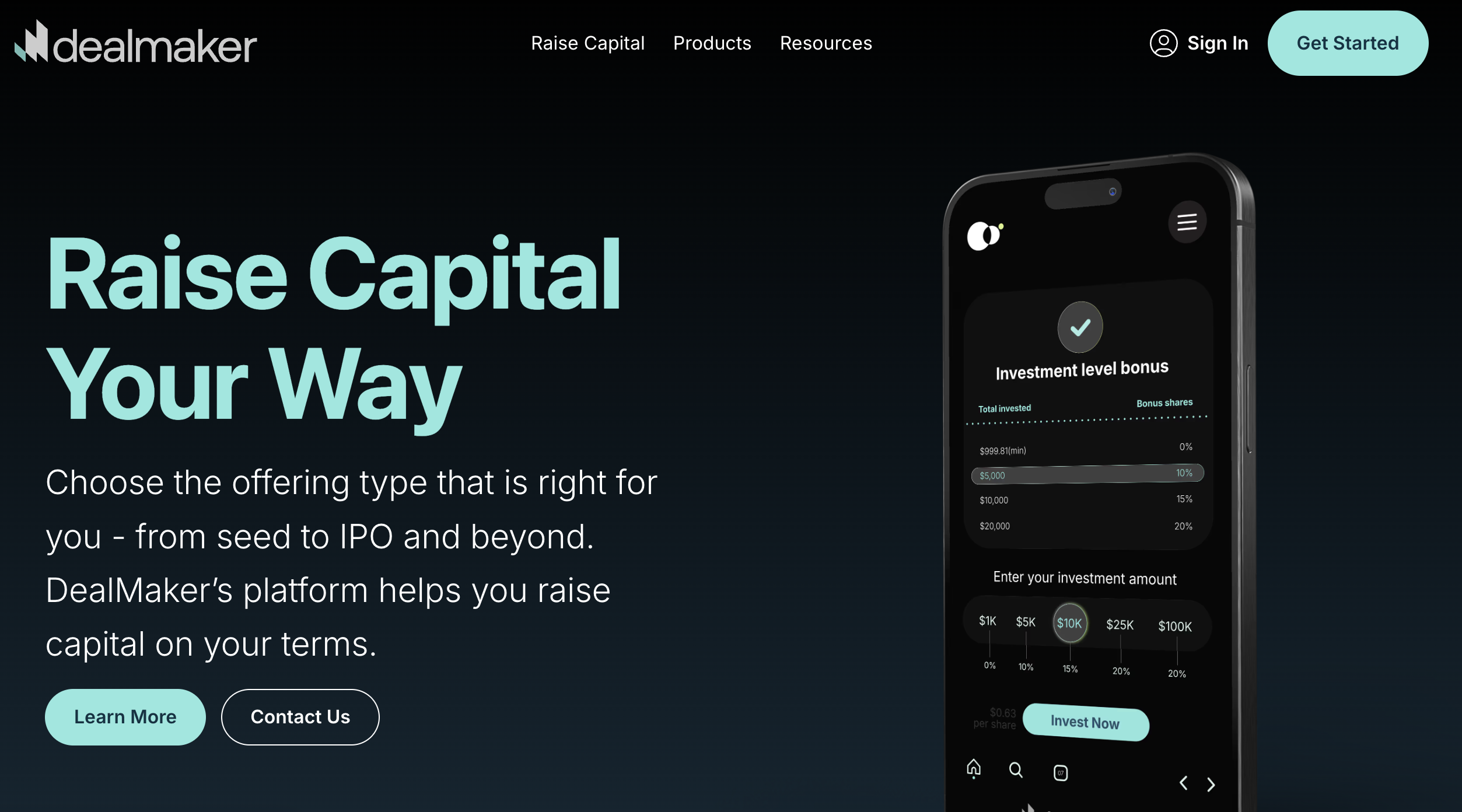
DealMaker is a different animal from most equity crowdfunding portals. They have been capturing market share with Reg A+ raises and continue to perform with Reg CF raises.
Rather than running a marketplace where investors browse a catalog of deals, DealMaker provides white-label technology that lets a company host its own raise. That way, you can use your own domain and brand.
DealMaker’s fees appear to vary. According to one issuer, it charges a “cash fee of an 8.5% commission based on the dollar amount of the Securities sold in the Offering. There is also a $32,500 advance setup fee and $11,500 monthly fee payable to the Intermediary and/or its affiliates.”
According to another, it charges a “(8.5%) commission” and a “$42,500 advance
setup fee and $15,000 monthly fee for marketing and platform services.”
5. CrowdCube

Crowdcube hosts a community of over 2 million registered investors and is one of the leading equity crowdfunding platforms for startups based in Europe.
Founded in 2011 and regulated by the FCA in the UK and the CNMV in Europe, it has facilitated more than £1.5 billion invested into private markets on its platform, backing companies including Revolut, Monzo, Moneybox, and Chip.
Crowdcube offers two raise types, and the fees differ. A Focus Raise costs £4,995 to list and carries a 5% success fee; a Full Access raise costs £9,995 and carries a success fee of up to 8%. On top of that sits a 2.5% platform fee on all funds raised, plus an annual nominee fee of £750 or £1,000 (waived for the first 12 months).
Some of Crowdcube’s biggest names have raised in the millions. Early Revolut backers did especially well: 433 investors put in just over £1m in 2016, and by late 2024 those shares were worth roughly 400x what they paid.
6. EquiFund
Equifund takes a more curated, boutique approach than the big marketplaces. By volume, Equifund is a smaller player — it reports over $150 million invested and committed to date
What I like about this platform is that they are much more transparent than their competitors and focus on learning content and webinars aimed at first-time private-market investors.
On the founder side, the fee structure is steeper than most. Equifund charges “7-8% of the gross proceeds (total amount raised) of each offering payable in cash and 0-7% equity of the offering sold under section 4(a)(6).”
For investors, Equifund charges a per-transaction fee of $24 across the board for each transaction, regardless of investment size.
7. HoneyComb Credit
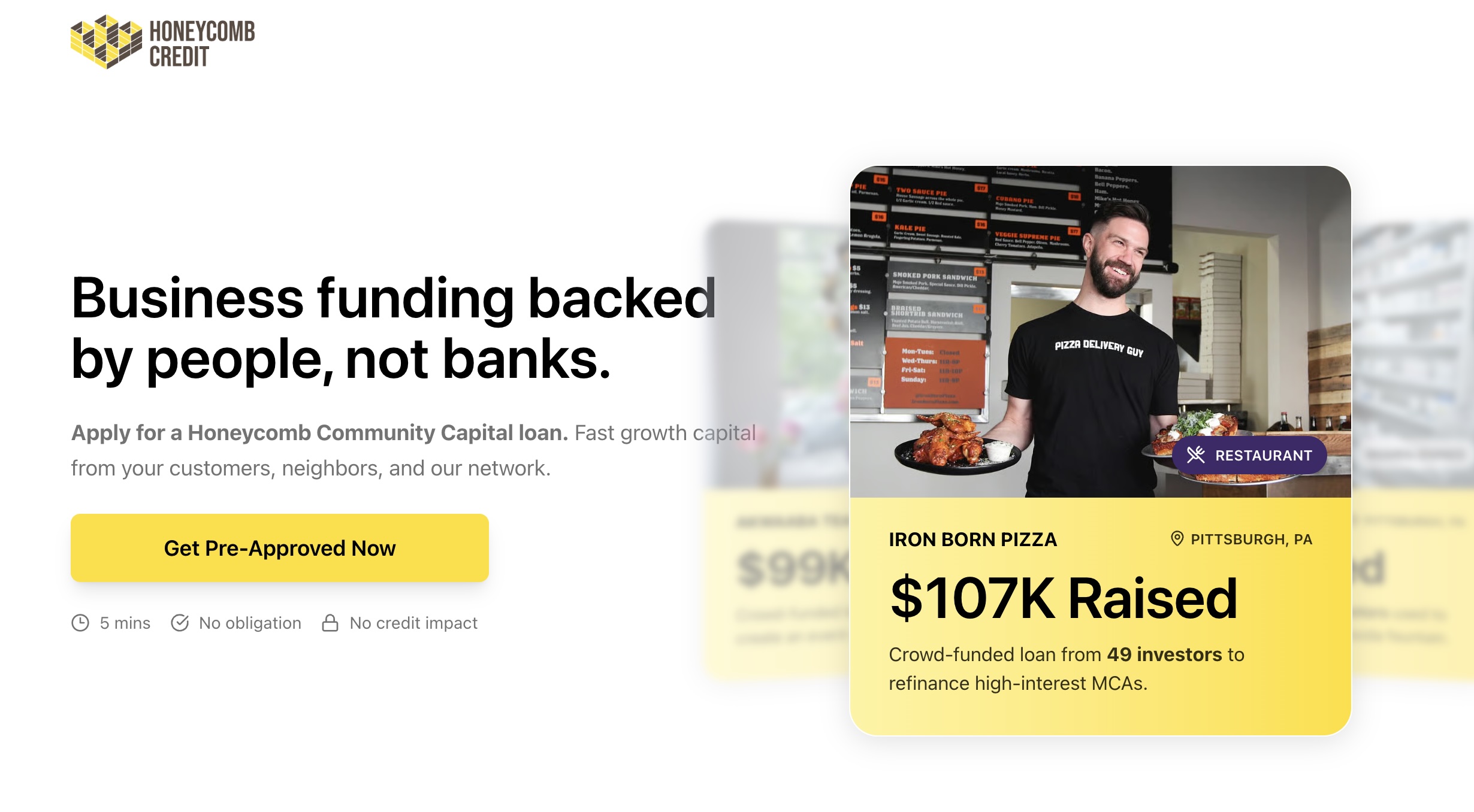
Founded in 2017 and headquartered in Pittsburgh, Honeycomb Credit takes a different approach from most equity crowdfunding websites. Instead of selling equity, small businesses raise fixed-rate loans with 3–5 year terms directly from their customers, neighbors, and fans.
Honeycomb has deployed over $23 million in community capital through more than 23,000 investments.
The platform has a community of over 20,000 investors and is built specifically for brick-and-mortar Main Street businesses like restaurants, bakeries, and retail shops that often struggle to get bank financing.
Rather than a subscription, businesses pay a roughly $250 posting fee plus a 6–8% success fee on funds raised once the campaign closes. Loans generally carry interest rates in the 6–14% range.
8. Netcapital
Founded in 2014 and headquartered in Boston, Netcapital is one of the longest-running Reg CF portals in the U.S., and it’s unique among the platforms on this list in that its parent company is publicly traded on the Nasdaq (ticker: NCPL).
The platform is open to both accredited and non-accredited investors, with investment minimums as low as $99 on many offerings, and it has grown to more than 100,000 users.
Companies can raise up to $5 million under Reg CF, and the platform also hosts Reg A+ and Reg D 506(c) offerings through its broker-dealer subsidiary, Netcapital Securities.
For Reg CF campaigns, Netcapital’s fees include a $5,000 listing fee, a 4.9% portal fee on capital raised at closing, and a 1% success fee paid in equity.
9. Climatize

Equity crowdfundng site Climatize has carved out a niche few other platforms touch: financing renewable energy infrastructure.
Rather than startup equity, developers raise debt through Regulation Crowdfunding to build solar farms, battery storage, and efficiency projects.
Accessibility is the keyword with Climatize. It opens every offering to non-accredited and accredited investors alike, with minimums starting at as little as $10 and projects targeting up to 10% annually.
Fees are charged to the developer, not the investor: a $5,000 commitment fee, a 5% origination fee on funds raised, and an annual servicing fee of 0.5% or $500, whichever is greater.
10. AngelList

Founded in 2010, AngelList has a long history as one of the original equity crowdfunding portals, and as a result, it has a powerful reputation with a growing community of investors.
AngelList is on a mission to connect angel investors with high-potential startups, and they cater specifically to tech companies.
Since 2013, they claim to have provided $6.3 billion worth of funds to tech startups, and this is part thanks to their unique syndicate model, which allows groups led by professional angel investors to pool their capital.
The syndicate model reduces the complexity of investor interactions for the startup founder, who enjoys the benefit of receiving funds from many investors while communication takes place chiefly through the lead investor only.
AngelList does not take any portion of funds raised. Instead, they offer three separate plans for startups priced at $50, $170, and $300 per month.
They also offer a free base plan for startups that have raised less than $1 million in capital, making them a very beginner-friendly option.
FAQ
Are there any good books on equity crowdfunding?
If you’re interested in learning all the ins and out of equity crowdfunding and raising investment capital for your business, you need to do your research.
That’s why I’d like to offer you a free copy of Equity Crowdfunding Explained, so you can learn how to get funding from the crowd in a matter of minutes.
You can get your free copy with a free trial of Audible now and start gathering the capital you need to take your business to the next level!
How much money can you raise with Reg CF?
Up to $5 million in any rolling 12-month period. That cap applies across all Reg CF offerings, so if you raised $2 million eight months ago, you’ve got $3 million of headroom left. Larger raises require Reg A+ (up to $75 million) or Reg D. I’ve laid out the full picture in this guide to Reg CF limits and how much you can raise.
Who can invest in an equity crowdfunding campaign?
Anyone 18 and up. That’s the whole point of Reg CF. Non-accredited investors can participate alongside accredited ones. Non-accredited investors do face annual caps based on their income and net worth, but the platform handles that calculation at checkout. Minimums on the platforms above run anywhere from $10 to $250.
Which equity crowdfunding platform is best for my startup or real estate offering?
There’s no universal answer, and anyone who tells you otherwise is selling something. Wefunder and StartEngine have the biggest retail investor bases in the United States. Personally, I like Republic’s investor-facing user interface.
Real estate crowdfunding platforms are a bit different, and I’d check out my article for an in-depth analysis, as there are additional considerations.
Is equity crowdfunding actually worth it?
Yes, in many cases. You raise capital without a single VC meeting, on your own timeline, at a valuation you set. You walk away with hundreds of customer-investors who now have a financial reason to buy from you, refer you, and defend you publicly.
There are real tradeoffs to weigh, like cap table structure, reporting obligations, the equity you give up, and I’ve laid them all out in my honest look at the equity crowdfunding pros and cons.
Do I need a big following before I launch an equity crowdfunding campaign?
It helps enormously, but it isn’t required. What kills most campaigns isn’t a small audience — it’s launching with no warm list at all and hoping the platform’s marketplace carries you. It won’t. Most successful raises front-load their investment raise before going public. Here’s my full equity crowdfunding marketing strategy for building that runway.
Do I need a lawyer or an agency to run a campaign?
You don’t strictly need either, but some founders will bring in an attorney for a complicated investment contract. Crowdfunding advisory, video production, ad management, and investor acquisition are the other common outsources. I maintain a directory of equity crowdfunding resources, experts, and service providers if you’d rather not vet vendors cold.
What paperwork do I need to file?
At minimum, a Form C with the SEC, which includes your business description, use of proceeds, risk factors, and financial statements. The level of financial review scales with how much you’re raising — smaller raises need certified financials, larger ones need a CPA review or full audit. Work through my Reg CF requirements checklist so nothing catches you off guard.
Conclusion
Equity crowdfunding is a great tool to empower private entrepreneurs and allow them to get investment capital from the crowd.
All great businesses need a passionate, driven entrepreneur with a group of inspired investors to support them. Once you get investors for your equity crowdfunding campaign, you can leave funding to them and keep growing your startup.
As long as you have a sense of direction and an idea you believe in, it really is just a matter of picking the right platform and knowing how to use it.
When it comes to crowdfunding websites for startups, there is no one-size-fits-all. It’s all a matter of what you and your business need most.
That’s why it’s worth your while to investigate all of the websites, portals, and platforms on this list and ask yourself what each one can do for your startup.
You may need to shop around a bit before you find your perfect match, but remember, the best equity crowdfunding website is the one that works for you.


